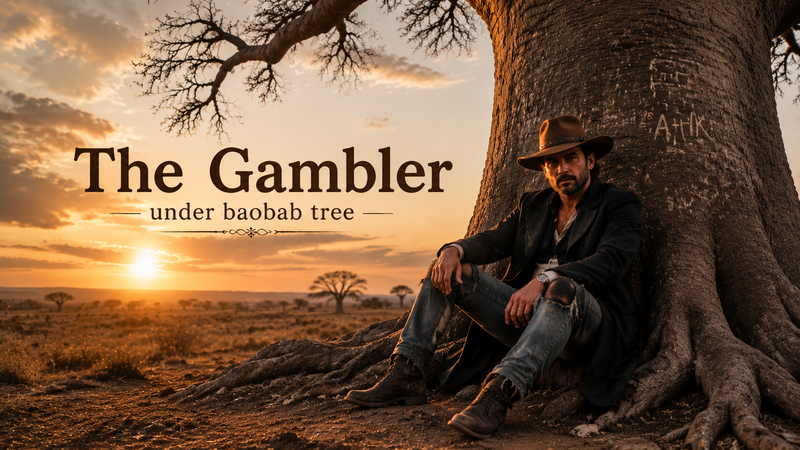
THE GAMBLER UNDER THE BAOBAB

Chapter 1: The Baobab’s Shadow
The sun stretched lazily across Kijiji, a small village tucked between rolling hills and dusty plains, painting the sky in shades of amber and gold. At the heart of the village stood the ancient baobab tree, its thick, gnarled branches spreading wide like the arms of an old guardian. Beneath its shade, villagers gathered for chatter, gossip, and most importantly, the infamous card games of Juma, the village’s most daring and reckless gambler.
Juma was a lanky man, wiry but nimble, with a grin that seemed permanently etched across his face. His eyes sparkled with mischief, and his hands moved with a speed and confidence that made even the most skilled villagers pause in awe. Today, he was the center of attention, flipping a worn deck of cards with theatrical flair.
“Juma!” barked Mama Njeri, the matriarch of the village, wagging her walking stick. “You better not cheat today, or I’ll tie you to this baobab myself!”
Juma bowed dramatically, his grin widening. “Mama Njeri, I would never! The spirits of the baobab are watching, and you know they favor honesty… and skill.”
The villagers chuckled, some shaking their heads at his audacity, others leaning in, eager to watch the unfolding spectacle. Children, wide-eyed and curious, peeked from behind baskets and goats. Even the elders, usually too stern to laugh, allowed themselves a faint smile.
Across the circle, Otieno, Juma’s lifelong friend and occasional voice of reason, whispered, “Juma, remember Mwangi? Thirty goats still aren’t paid. Don’t let your charm fool you.”
Juma waved a hand dismissively. “Otieno, thirty goats? Mere trifles! Today, the spirits are with me. I feel it in my bones!”
As if summoned by fate, Mwangi stepped into the circle. The newcomer had arrived quietly days before, but rumors already painted him as a formidable player, calm and calculating, with a reputation that sent shivers through anyone who owed him favors. He carried a small pouch that jingled faintly, the sound catching the sunlight like scattered coins.
Juma’s grin widened. “Ah, Mwangi! Come to test your luck against the master of the baobab?”
Mwangi’s eyes glinted. “I’ve heard of you, Juma. Let’s see if your reputation matches your skill.”
The villagers leaned in, sensing a storm brewing. This wasn’t just a friendly game—this was a test of pride, courage, and skill, with stakes higher than ever.
The game began. Cards flipped, laughter erupted, and bets were placed: a handful of millet, a chicken, a gourd of homemade brew. Soon, Juma, ever the showman, raised the stakes with a goat, then, jokingly at first, his late father’s old pocket watch.
Otieno’s eyes nearly popped out. “Juma! That watch—do you even know what it’s worth?”
“Exactly!” Juma said, spinning the watch on his finger. “Today, I show courage and respect for the game!”
The crowd murmured. Some whispered, “Madness!” Others grinned, anticipating the drama. Children mimicked Juma’s gestures, laughing as the tension thickened.
Mwangi, calm and deliberate, laid his cards with precision. The game swung like a pendulum—Juma won some rounds, lost others, but always with flair. The villagers’ excitement grew. Laughter, gasps, and cheers mingled in the dusty air.
Then, a sudden hush fell. The baobab’s shadow stretched across the circle, swallowing the players and spectators in its cool, ancient shade. The air seemed to thrum with anticipation. Even the wind paused.
Juma’s hand hovered over his cards, tension tightening his chest. Mwangi’s expression betrayed nothing, yet every flicker of his eyes seemed to predict Juma’s moves. The stakes had shifted from possessions to pride, from pride to legacy.
“Juma,” Mwangi said softly, “this game is more than luck. It’s about courage, wisdom, and choice. Are you ready?”
For a heartbeat, Juma’s grin faltered. But he laughed it off, shrugging. “I was born ready.”
A distant goat bleated, breaking the tension, and the crowd exhaled in relief and laughter. But under the baobab, the wind whispered secrets of games past, of victories and failures. The ancient tree seemed to lean closer, as if to watch whether Juma would rise triumphant or tumble into folly.
As the sun sank behind the hills, painting the village in deep shades of amber and violet, the first chapter of Juma’s tale under the baobab closed, leaving the villagers—children, elders, and playful spirits alike—wondering: Would Juma’s luck hold, or was this the day the baobab claimed its due?
And somewhere, in the roots of the great tree, old secrets stirred, waiting for the right moment to reveal themselves.
Chapter 2: A Bet Too High
The morning sun spilled golden light across Kijiji, waking the village with its usual chorus: roosters crowing, goats bleating, and children shrieking as they chased each other across the dusty paths. But today, beneath the ancient baobab, a different kind of excitement filled the air. The story of Juma’s daring gamble yesterday had spread faster than the wind over the plains, and villagers gathered in greater numbers than ever.
Juma strolled toward the baobab with the swagger of a man untouchable. His grin was wider than usual, almost smug, as Otieno fell in step beside him, muttering under his breath.
“Juma, thirty goats are still owed to Mwangi,” he warned. “Do you want to risk your father’s watch today too?”
“Otieno,” Juma replied, twirling the watch between his fingers, “a true gambler knows that fortune favors the bold. Today, I claim my destiny!”
Otieno groaned, knowing better than to argue. Boldness, in Juma’s case, always teetered on the edge of foolishness.
By mid-morning, the crowd had formed a wide circle beneath the baobab, and Mwangi arrived, calm and unreadable as ever. He carried his small pouch, jingling faintly like a warning bell. Villagers whispered, “Here comes the shadow of yesterday’s luck,” and eyes darted between Juma and Mwangi, waiting for the inevitable clash.
Juma clapped his hands dramatically. “Friends, villagers, witnesses of destiny! Today, we play for pride, courage, and treasures worthy of legends!”
The crowd erupted in cheers and laughter. A few elders shook their heads, muttering, “This boy will either become a hero… or disaster.”
The game began with customary small bets—millet, chickens, a gourd of palm wine—but Juma, never one for subtlety, quickly raised the stakes. “A goat!” he announced, pointing to a proud animal tethered nearby. Villagers gasped.
“Bold,” Mwangi said softly, laying down his cards. “But are you ready for consequences?”
Juma laughed, though a flicker of doubt crossed his mind. “Consequences, my friend, are the spice of life!”
The game escalated fast. Cards flipped, coins clinked, and the crowd roared with delight. Juma’s overconfidence shone through every move, each flourish earning gasps and laughter from spectators.
Then, in a moment of pure bravado—or madness—Juma slid the heirloom pocket watch across the dusty ground. A hush fell. Children froze mid-step, goats paused mid-bleat, and even the wind seemed to hold its breath.
Otieno’s eyes widened in horror. “Juma! The watch! Do you even know what it is?”
“I do,” Juma said, spinning it on his finger. “It is proof that courage is stronger than fear!”
Mwangi’s lips curved slightly, an expression so subtle it might have been mistaken for disinterest. Yet the village could sense the tension. Something in Mwangi’s gaze hinted that today’s game was no ordinary gamble.
The cards were dealt again. Juma’s hand shook slightly as he held them, not from fear, but from the thrill of the risk. Mwangi remained calm, almost statuesque, flipping his cards with deliberate precision.
Round after round, Juma won and lost in a dizzying cycle. Laughter and mock protests erupted, blending with the clatter of coins and the bleating of goats. Villagers placed side bets in absurd ways. One old man wagered a cow, another a sack of yams, and one mischievous child bet a clay figurine he had made.
As the sun climbed higher, the stakes climbed with it. Juma had already risked two goats and the watch. The air seemed to thrum with tension as every villager leaned in closer, holding their breath.
Suddenly, Juma miscalculated. A bold bluff failed, and he lost a prized goat. The crowd gasped, some in sympathy, others in gleeful amusement. Akinyi, Juma’s younger sister, ran forward, her hands on her hips.
“Juma! Are you insane?” she scolded. “Do you realize what you’re risking? That goat fed the family this week!”
“Ah, sister,” Juma said, raising his hands in mock surrender, “this is not loss, but learning!”
Otieno shook his head. “Learning doesn’t put food on the table, Juma.”
Meanwhile, Mwangi watched silently, his expression betraying nothing, yet his eyes seemed to pierce Juma’s bravado. It was as if he knew something no one else did, a secret tethered to the past and the baobab itself.
Desperate to reclaim his honor, Juma doubled down. “All or nothing!” he shouted, pushing the watch forward once more. The crowd erupted in murmurs. The stakes had never been higher.
A gust of wind swept across the clearing, and the watch swung dangerously. Children gasped; goats brayed. Juma lunged, snatching it just in time, and the villagers laughed, partly from relief, partly from awe at his daring.
Mwangi leaned back and whispered softly, “Clever… but cleverness alone does not win the game.”
Juma straightened, a glint of mischief returning to his eyes. “Then let the game continue,” he said, “for the spirits of the baobab guide the bold and bless the foolish!”
As the shadows of the baobab stretched long into the afternoon, the tension wrapped the village in its invisible cloak. Everyone knew one wrong move could cost Juma everything—goats, pride, or even his family’s trust. And somewhere, deep within the roots of the baobab, the secrets of his father’s past stirred, waiting for the right moment to reveal themselves.
For Juma, today was more than a gamble—it was a test of courage, cunning, and heart. And though he laughed, joked, and charmed the villagers, a quiet voice in the back of his mind whispered: some bets are bigger than anyone dares to play.
The first gambles of the morning had ended, but the real game—the one that would test Juma’s luck, wisdom, and legacy—was only beginning.
Chapter 3: Secrets of the Baobab
By the time the sun dipped low behind the distant hills, painting Kijiji in a wash of orange and gold, Juma felt a strange unease gnawing at him. Yesterday’s games under the baobab had left the village buzzing, and today’s gambles had taken him closer to ruin—or revelation. As he walked home, Otieno fell in step beside him, carrying a bundle of maize he had collected for his family.
“Juma,” Otieno said, his voice quiet, “you cannot keep playing like this. That Mwangi… he is no ordinary man. I’ve never seen anyone read a bluff like he does.”
Juma chuckled, brushing off the warning. “Relax, my friend. The baobab protects those who respect it—and I respect it more than anyone.”
But deep down, a small seed of doubt had planted itself in Juma’s mind. His father’s old pocket watch now rested safely in his pocket, but its weight felt heavier than gold. Something about Mwangi unsettled him, as if he were staring into the past itself.
When Juma reached the baobab later that evening, curiosity drew him closer to the tree’s massive roots. He had noticed, during the games, a small hollow that seemed almost deliberately concealed—a cavity in the trunk, shadowed by moss and age. Tonight, with the village quiet and the goats settled, he decided to investigate.
“Otieno,” Juma whispered, “help me check this out. Something tells me there’s more to the baobab than shade and luck.”
Otieno, cautious as always, sighed. “Fine, but if this ends with us being chased by spirits or Mwangi’s men, don’t say I didn’t warn you.”
Together, they knelt by the tree. Juma’s fingers probed the hollow and, after a moment of fumbling, pulled out a small leather pouch. Inside were coins that glinted faintly in the fading sunlight, and a stack of yellowed letters tied with a faded ribbon. Juma’s heart raced.
“These… these belonged to my father?” he whispered, holding the letters carefully.
Otieno leaned closer. “Looks like it. But why hide them here?”
Juma opened the first letter. The handwriting was familiar yet haunting, a reminder of a man both respected and feared in the village: his father. The letter spoke of debts, of games lost and won, and of someone ominously named Mwangi, though no surname was given. One line stood out, written in careful cursive:
“Luck can be borrowed, but never stolen. Honor lies in wisdom, not just in courage.”
Juma frowned. “Otieno… this… this isn’t just about gambling. My father owed someone… maybe this Mwangi. Could it be the same man?”
Otieno’s eyes widened. “Are you saying… Mwangi is here because of your father?”
Juma nodded slowly. “It seems likely. And if that’s true, he isn’t just a rival. He’s… settling a score.”
The weight of realization sank in. All of Juma’s bravado, all his jokes and daring, suddenly felt fragile. The stakes were no longer chickens, goats, or even a pocket watch—they were legacy, respect, and possibly danger.
A rustle in the branches above made them both jump. A monkey chattered, breaking the tension, and Juma laughed nervously. “Even the spirits are watching us now, Otieno. The baobab whispers secrets only the brave—or foolish—dare uncover.”
Otieno shook his head. “You’re too curious for your own good.”
But Juma’s curiosity could not be quelled. The letters revealed more: names of men and women, debts called in long ago, and cryptic warnings about games that were never truly finished. One letter even mentioned a hidden stash of coins meant to repay a long-standing debt—or perhaps to tempt someone into another game of chance.
As they examined the pouch, Juma noticed a faint pattern etched inside the leather—a symbol he recognized from old carvings in his father’s home: a small baobab with three dots beneath it. The meaning eluded him, but the familiarity sent chills down his spine.
“What does it mean?” Otieno asked, pointing to the marking.
“I don’t know yet,” Juma admitted, “but I think… it’s a sign. A warning, maybe. My father left clues, perhaps to guide me, perhaps to protect me. Or maybe… to lure me.”
The shadows of the baobab stretched across the ground as the sun disappeared entirely, leaving the village bathed in twilight. The air was thick with anticipation, a tension that seemed almost tangible. Somewhere in the distance, goats bleated, and a dog barked. But beneath it all, the baobab seemed alive, guarding the secrets it had held for generations.
Juma rose to his feet, stuffing the letters back into the pouch. “Otieno,” he said, determination returning to his voice, “I need to understand this. I need to know the truth about my father, about Mwangi, and about this game that never truly ended.”
Otieno frowned. “And what if the truth is dangerous?”
Juma smiled, though it was tinged with seriousness. “Then we face it. Like always. Under the baobab, everything has a witness. And now… so does the past.”
As the two friends walked back toward the village, the pouch secure in Juma’s hand, the wind whispered through the baobab’s leaves. It carried a voice from long ago, faint but clear: “Some debts cannot be ignored, some games never truly end, and some gambles… will shape your very soul.”
Juma felt a shiver run down his spine. The baobab had revealed its first secret. But he knew there were more—secrets that could change everything. And as the night settled over Kijiji, Juma realized that the true game was only just beginning.
He looked at Otieno, eyes gleaming with a mixture of fear and excitement. “Tomorrow,” he whispered, “we play… not just for goats, not just for a watch… but for something far greater.”
Otieno grunted. “I have a feeling tomorrow, the baobab won’t just be watching. It’ll be judging.”
Juma laughed softly. “Then let it judge. I’ve never been one to shy away from a challenge.”
The village slept peacefully under the sprawling branches of the baobab, unaware that a story of family, fate, and gambling was unfolding—one that would test courage, wisdom, and loyalty like never before.
Chapter 4: Mwangi’s Move
The morning sun filtered through the baobab’s thick branches, scattering dappled light across the dusty clearing. Kijiji was awake, buzzing with anticipation. Word had spread quickly: Mwangi had issued a challenge to Juma, one unlike any other. Villagers whispered excitedly, some shaking their heads, others rubbing their hands in glee. The air smelled of anticipation, goat dung, and roasted maize.
Juma arrived with his usual swagger, the heirloom watch safely tucked in his pocket. Otieno trailed behind, carrying a sack of millet and casting nervous glances around the clearing. “Juma,” he muttered, “this isn’t like the other games. Mwangi… he isn’t playing for chickens anymore. You need to be careful.”
Juma grinned, brushing off the warning. “Otieno, relax. Today, we play like men under the gaze of the baobab. Courage, wit, and a little luck—those are all we need.”
Mwangi was already there, seated calmly on a low wooden stool. His pouch of coins lay at his side, catching sunlight and drawing the villagers’ eyes. He had a small smirk on his face, one that promised danger and challenge in equal measure.
Juma stepped forward dramatically. “Mwangi! Today, we raise the stakes higher than ever before. No more chickens, no more goats! Today, we play for pride and honor!”
The villagers erupted in murmurs and laughter. Some elders shook their heads, muttering, “This boy will either make legends… or tragedy.” Children giggled, mimicking Juma’s grand gestures.
Mwangi looked up, his calm eyes meeting Juma’s. “I heard of your boldness, Juma. Let us see if it matches your reputation.”
The stakes quickly escalated. Juma placed a goat first, then a woven basket of maize, and then, with dramatic flair, the pocket watch. The villagers gasped. Some whispered nervously; others whispered bets. “I bet he spills the brew!” one said. “I bet he loses his hat!” another teased.
“Today,” Mwangi said softly, “we play not just for what is seen, but for what is unseen. Every move, every gesture, every glance… it tells a story.”
The game began. Cards flipped with rapid precision, coins clinked, and the villagers leaned in, enraptured. Laughter erupted at some of Juma’s more daring bluffs, gasps followed Mwangi’s silent victories.
Otieno muttered under his breath, “Juma, this isn’t just a game. It’s a war of minds.”
Juma laughed, ignoring the warning. “Then I fight with charm and skill!”
The first few rounds went predictably: Juma won some, lost some. The villagers cheered, laughed, and heckled with wild abandon. Children jumped, goats bleated, and one mischievous boy even tried to sneak a peek at Mwangi’s cards, only to be shooed away by a stern elder.
But then Mwangi made a move that made even Juma’s grin falter. He laid down a hand of cards that seemed impossible, calculated, like the culmination of years of practice and patience. The crowd went silent. Even the wind seemed to pause.
Juma’s fingers twitched. He knew the stakes had just shifted from playful to serious. A sudden thought struck him: Mwangi knows more than he should. More than any newcomer ought to know.
Determined not to be intimidated, Juma raised the stakes further. “All or nothing!” he shouted, tossing in another goat and the heirloom watch. The villagers gasped. Some cheered; some muttered in disbelief. Akinyi, his younger sister, covered her face with her hands and groaned.
“Juma!” she hissed, “this is insane! That watch is priceless!”
Otieno sighed. “And he’s about to lose everything, just for pride.”
The game continued, the sun climbing higher, sweat forming on foreheads, and tension wrapping around the baobab like a living thing. Every card flipped, every coin placed, every glance between Juma and Mwangi carried weight far beyond simple gambling.
In the midst of this, humor found its place. A goat wandered into the circle, scattering coins and cards, and the villagers erupted into laughter. “Even the animals want to play!” someone shouted. Another child cried, “Stop! The goat is cheating!” Juma, despite the stakes, laughed too. Humor and chaos always seemed to follow him.
But Mwangi’s expression remained unchanged, a calm, almost eerie mask. There was a precision to his movements, a silence to his strategy that unnerved everyone, including Juma. He realized that this was no ordinary rival. Mwangi was not playing for fun; he was settling a score—and perhaps testing Juma for something far greater.
As the rounds continued, Juma noticed patterns in Mwangi’s play that hinted at knowledge of his father’s past, of debts and secrets buried long ago. The letters Juma had found under the baobab earlier flashed in his mind. Could Mwangi have known about them? Had he been waiting, watching, all this time?
The sun began its descent, casting long shadows across the dusty ground. The game had stretched into hours, and neither Juma nor Mwangi had faltered. Sweat streaked faces and dust clung to skin, but both remained resolute, their eyes locked in silent battle.
At last, Mwangi laid down a final hand. Juma’s heart pounded in his chest. The crowd leaned in so close they could feel the tension as if it were a physical force. For a moment, even the wind seemed to hold its breath.
“Clever,” Mwangi said quietly, “but remember… cleverness is not victory. It is only preparation.”
Juma swallowed hard, realizing that today’s challenge was not just a game of chance—it was a test of courage, skill, and heart. He squared his shoulders and smiled, determination blazing in his eyes.
“Then let the game continue,” Juma said, “for as long as the baobab watches, luck favors the bold and the brave!”
The villagers erupted into cheers and laughter once more, some clapping, some shaking their heads in disbelief. And as the shadows of the baobab stretched long into the evening, the first real battle between Juma and Mwangi had begun—one that would test the very limits of courage, wisdom, and the power of legacy.
Chapter 5: The Lost Goat
The day dawned with a crisp breeze that swept across Kijiji, rustling the dust and dry leaves beneath the baobab. Villagers awoke to the news that Juma and Mwangi’s high-stakes game would continue. The rumor spread faster than smoke from a cooking fire: “Juma’s risking goats, land, and… something else!”
Juma, however, strode to the baobab with his usual confidence, though a shadow of worry crept across his brow. Otieno trailed behind, carrying a bag of millet and muttering warnings about pride, recklessness, and the wrath of Mwangi.
“Juma,” Otieno said quietly, “do you realize how far this has gone? Yesterday, it was a goat and a watch. Today… I hear you’ve offered pieces of your family land.”
Juma laughed, brushing off the caution. “Otieno, my friend, luck favors the bold. You worry too much. We play for honor and excitement!”
The villagers gathered early under the baobab, forming a tight circle. Children ran through the gaps, goats meandered among spectators, and elders shook their heads in a mix of worry and amusement. The excitement was palpable; everyone knew today’s game would have real consequences.
Mwangi was already there, seated with the air of a man who owned time itself. The pouch of coins at his side glinted faintly in the morning sun, as though daring anyone to challenge him. His gaze fell on Juma, calm yet piercing.
“Juma,” Mwangi said softly, “today, the stakes will speak louder than words. Are you ready?”
Juma grinned, though his fingers clenched slightly. “I was born ready. Let the game continue!”
The game unfolded with relentless energy. Cards flipped, coins clinked, and goats scattered with every sudden movement. Juma’s boldness carried him through the first few rounds, winning and losing in equal measure. The villagers cheered, laughed, and occasionally gasped. Children placed absurd side bets, from pieces of clay to marbles, adding a playful chaos to the tense atmosphere.
But then, a crucial round arrived. Juma, overconfident as always, made a miscalculation—a daring bluff that Mwangi read perfectly. In an instant, Juma lost a prized goat. The crowd gasped collectively.
Otieno’s face went pale. “Juma… no! That goat!”
Juma’s grin faltered, replaced by a tight-lipped determination. The goat was not just an animal—it represented his family’s sustenance, pride, and the stakes of his reckless gambling.
Akinyi, Juma’s younger sister, rushed into the circle, her hands on her hips and a mix of frustration and fear on her face.
“Juma! Are you insane?” she shouted. “That goat feeds the family! You cannot throw away everything for this… this madness!”
Juma raised his hands in mock surrender, though his heart pounded fiercely. “Sister, it is not madness! It is courage! And skill! And… well, luck, too!”
Otieno muttered under his breath, “Sometimes, courage isn’t enough…”
The villagers, sensing the tension, leaned in closer. Some whispered warnings; others chuckled at the absurdity of Juma’s antics. One elder, shaking his head, muttered, “Pride will be his downfall, mark my words.”
Mwangi, calm and unyielding, collected his winnings without a word. The precision in his movements, the cold calculation of his eyes, made it clear: he was no ordinary opponent. This game was personal, and he knew the depths of Juma’s recklessness.
The loss of the goat sent a ripple of unease through Juma. He realized, for the first time, that this game was about more than cards or animals—it was about legacy, trust, and honor. Each loss chipped at his confidence, each round tested his cunning.
Desperate to regain control, Juma tried to bluff, to charm, to manipulate the flow of the game. Yet Mwangi remained unfazed, reading every gesture and motion with unnerving accuracy. The stakes grew higher—both literally and figuratively.
In the midst of the tension, the village found moments of comic relief. A goat wandered too close to the card circle, knocking over coins and scattering cards. Children squealed in delight, pointing and laughing. Juma, despite the seriousness of the moment, couldn’t help but chuckle. Humor had a way of surviving even the highest stakes.
But the laughter could not mask the looming danger. Juma felt it deep in his bones: the baobab, ancient and knowing, seemed to watch silently. Its shadow stretched long over the clearing, as though warning him that one more misstep could cost him everything.
Finally, the round ended. Juma had managed to save the pocket watch, but the loss of the goat stung sharply. He looked around at the villagers, some sympathetic, some amused, all captivated.
Akinyi shook her head, exasperated but relieved that he hadn’t lost more. “Juma,” she said softly, “this… this is dangerous. You must think beyond the thrill.”
Juma nodded, a flicker of seriousness crossing his face. “I understand, sister. But the game… the game is never over. Not until the last card is played.”
Otieno placed a steadying hand on his friend’s shoulder. “Then we must play smart. Not just bold. Mwangi is not ordinary. He’s… different.”
As the sun climbed higher, the villagers began dispersing, leaving whispers and speculation in their wake. But Juma stayed beneath the baobab, staring at the roots, the pocket watch in hand, and the hollow where he had found the letters the night before. The loss of the goat had changed something; it had made the stakes painfully real.
Juma realized that winning the game would require more than charm and bravado—it would require wisdom, courage, and perhaps the guidance of the baobab itself. Somewhere in the shadows of its massive branches, secrets stirred, waiting to reveal themselves.
And as the wind rustled the leaves, Juma understood: the true gamble was only beginning, and the cost of failure was far higher than he had ever imagined.
Chapter 6: Midnight Schemes
Night draped Kijiji in a velvet cloak, and the village lay in slumber beneath a sky painted with countless stars. Only the distant hoot of an owl, the soft bleating of goats, and the gentle rustle of the baobab leaves punctuated the quiet. But beneath the ancient tree, the shadowed roots concealed two figures crouched in secret planning.
Juma and Otieno leaned close together, their faces half-hidden by the darkness. In Juma’s hand was the leather pouch of letters and coins he had discovered days before—a reminder of the stakes, the secrets, and the danger that loomed.
“Otieno,” Juma whispered, eyes gleaming, “tonight, we reclaim what Mwangi has taken. The goat, the pride… perhaps even more. But we must be careful. One misstep and…”
“And we become the punchline of the village gossip for the next ten years,” Otieno finished grimly. He scanned the clearing, making sure no wandering villager would stumble upon them. “I swear, Juma… you have a knack for turning mischief into life-or-death situations.”
Juma grinned. “Adventure is nothing without a bit of risk, my friend. Now, the plan…”
They crept along the perimeter of Mwangi’s compound, silent as shadows themselves. The compound was modest but tidy, guarded only by a few scattered dogs, a rooster that occasionally crowed, and an assortment of startled chickens. Perfectly ordinary—or perfectly deceptive, Otieno thought.
Juma crouched low, pointing to a stack of crates near Mwangi’s entrance. “We sneak in here, under the cover of darkness. Quick, quiet, and precise. Grab the goat—or at least make it ours temporarily—and slip back to the baobab.”
Otieno sighed. “Temporary or permanent, it’s still theft, Juma. And Mwangi… he doesn’t strike me as the forgiving type.”
“Details, details,” Juma replied with a wink. “Tonight, we are shadows beneath the baobab, whispers in the wind, legends in the making!”
They waited for the perfect moment. The dogs had settled, the chickens were asleep, and the moon had risen high enough to cast silver light, illuminating the edges of the compound without giving away their position. Juma motioned for Otieno to follow, and they began their slow crawl toward the goat pen.
The first obstacle was a stray dog, a scruffy little creature that yipped at the slightest sound. Otieno froze, holding his breath, as Juma waved a hand dramatically. The dog, unimpressed, wandered off after a tempting smell of maize.
“See? Nothing to worry about,” Juma whispered.
Otieno gritted his teeth. “I swear, this is going to end in disaster.”
By the time they reached the goat pen, tension gripped Juma like a vice. The goat—proud, stubborn, and very much aware—was tied with a rope that looked deceptively simple. Juma approached cautiously, trying to calm the animal with soft murmurs.
“Easy now,” he whispered. “Tonight, you and I are allies… temporary allies, mind you.”
Otieno, meanwhile, scanned the compound. A shadow flickered near the main hut. “Juma… someone’s moving!”
Juma’s eyes widened. “Stay calm… maybe it’s just a branch…”
But Mwangi stepped into the moonlight, his calm demeanor making the hairs on the back of Juma’s neck stand on end. He did not shout. He did not chase. He simply watched, his eyes narrowing slightly.
“You two,” Mwangi’s voice was soft but carried a weight that made the night seem heavier, “do you think the baobab is merely shade, or do you understand that it sees and remembers?”
Juma froze mid-step, the goat almost slipping from his grasp. Otieno’s face paled.
“We… we thought it… we thought we could…” Juma stammered, trying to find his bravado.
Mwangi’s gaze never wavered. “Courage is admirable. Recklessness is dangerous. Tonight, you test not just your skill, but your wisdom.”
Juma realized that Mwangi wasn’t angry—he was teaching, or warning, or perhaps testing. The baobab loomed above them, ancient and knowing, and for the first time, Juma felt truly small beneath its shadow.
Otieno whispered, “Maybe we should retreat.”
But Juma, fueled by stubbornness, pride, and a hint of thrill, shook his head. “No… we learn by risk, Otieno. We go carefully, quietly, wisely.”
Step by cautious step, they freed the goat and guided it toward the edge of the compound. Mwangi followed at a distance, silent as a shadow, never intervening but always watching. The thrill of danger, the pulse of fear, and the laughter that bubbled quietly between them kept Juma’s heart pounding.
Then, disaster nearly struck. Otieno tripped over a small pot, sending it clattering across the ground. The goat bleated loudly, and for a terrifying moment, it seemed all was lost. But Mwangi simply raised a hand, and the village dogs quieted, the shadows stilled, and the moment passed.
Juma laughed quietly, shaking his head. “Even in chaos, there is order. Even in failure, there is lesson. Tonight… we succeed, barely, but we succeed.”
With the goat safe and the pouch of coins still in hand, Juma and Otieno slipped back toward the baobab. Mwangi’s presence lingered like a shadow behind them, but he did not intervene. The message was clear: courage and cunning can win small victories, but wisdom is needed to survive the game itself.
Back under the baobab, the goat bleated softly, as if aware that it had been rescued not by luck alone, but by a combination of daring, strategy, and perhaps a touch of foolishness. Juma patted its head gently.
“Tonight, Otieno,” he said, “we learn. And tomorrow… we play again, stronger, wiser, bolder.”
Otieno could only shake his head, a mixture of admiration and exasperation in his eyes. “I swear, Juma, you make gambling sound like philosophy.”
Juma grinned. “Philosophy, adventure, and a little madness… that’s the recipe for life under the baobab, my friend.”
The wind rustled the leaves above, carrying a whisper through the night: “Every gamble leaves a trace. Every choice echoes in shadows. Every legend begins with a step into the dark.”
And so, beneath the ancient baobab, two friends, a stubborn goat, and the weight of history marked the beginning of a night that would be remembered as both daring and dangerous—the night when Juma and Otieno learned that the greatest gambles require both heart and wisdom.
Chapter 7: The Turning Tide
The morning sun burned low across the horizon, spilling amber and gold across Kijiji. The village had awakened to a buzz of whispers: Juma and Mwangi’s game had entered uncharted territory. Chickens, goats, coins—these were no longer sufficient. Today, stakes of legacy, secrets, and reputation hovered in the dusty air beneath the baobab.
Juma arrived with his customary swagger, though a tension threaded through his movements. The night’s midnight escapade with Otieno had left him exhilarated but wary. He had learned that courage alone would not win against Mwangi; he needed strategy, wit, and control over his impulses.
Otieno trailed behind, his expression a mix of concern and admiration. “Juma,” he whispered, “tonight we were lucky. Mwangi didn’t intervene. But luck alone won’t save you now. He knows your tricks, your history… perhaps more than you do.”
Juma smirked, though the edge of tension in his eyes betrayed him. “Then it’s time to raise the stakes in ways he cannot anticipate. Today, the game isn’t just for the past—it’s for our future.”
The villagers gathered, forming a wider circle than ever before. Children scampered among the goats and baskets, mimicking Juma’s flamboyant gestures. The elders shook their heads knowingly, murmuring, “The boy courts disaster… or glory.”
Mwangi was already present, seated with an air of calm command. The pouch of coins lay beside him like a silent sentinel, and his eyes, cool and measured, fixed on Juma with an intensity that made the young gambler’s heart quicken.
“Juma,” Mwangi said softly, “you have learned courage and audacity. But do you understand patience, timing, and consequence?”
Juma laughed, masking the flutter of unease in his chest. “I understand that the baobab watches, and the bold are rewarded!”
The first rounds began. Cards flipped, coins clinked, goats bleated, and laughter mingled with gasps. Juma played with flair, as always, charming the crowd and teasing Mwangi with bold bluffs. Yet, beneath the surface, tension coiled like a snake ready to strike.
Then came the critical moment: Mwangi laid down a hand that no trick, charm, or bluff could counter. The crowd went silent. Even the wind seemed to pause. Juma had underestimated his opponent.
Otieno muttered under his breath, “This is no ordinary hand… he’s planning something deeper.”
Juma’s grin faltered. For the first time, he realized that his opponent was not merely playing a game—he was orchestrating a lesson, a test, a trap.
“You see, Juma,” Mwangi said quietly, “games are more than chance. They are mirrors. They reveal your character, your choices… your limits.”
The crowd leaned in, sensing the tension thickening like fog. Children held their breath. Elders exchanged glances. Every eye was on the two men beneath the baobab, whose stakes had escalated beyond livestock and coins.
Juma’s mind raced. He had learned much in the past nights—about courage, cleverness, and the weight of family legacy. But now, the true turning tide approached.
With a decisive move, Mwangi raised the stakes further. “One final round,” he said, “for what truly matters.”
The words sent a ripple through the crowd. The villagers murmured in disbelief. One elder whispered, “He dares not… or perhaps he must.”
Juma’s heart pounded. He understood immediately: this was no ordinary gamble. Mwangi’s final hand would determine not just the game, but the fate of Juma’s pride, possessions, and perhaps even his family’s trust.
He glanced at Otieno, whose eyes mirrored his own mix of excitement and fear. “We cannot fail,” Juma said quietly. “Everything we’ve learned, everything we’ve risked… it comes down to this.”
The cards were dealt, each flip sounding like a drumbeat of destiny. Juma’s hands trembled slightly, betraying his internal tension, though he forced a grin. Mwangi’s movements were precise, measured, almost ritualistic, as if he were not just playing but guiding Juma toward a revelation.
The villagers leaned in closer. Silence stretched long and taut. Even the goats seemed aware of the importance of the moment, bleating only softly.
Then it happened. Juma misread a subtle signal, a slight flick of Mwangi’s eyes that he had overlooked. His hand, once confident, wavered. The realization struck him like lightning: the tide had truly turned. He was no longer leading the dance; he was reacting, trying to catch up to a rhythm set by Mwangi.
The loss was immediate. A prized goat—a symbol of sustenance and pride—was now Mwangi’s. The villagers gasped collectively, some with awe, others with concern. Akinyi cried out, “Juma! How could you?”
Juma’s face reddened, but he did not despair. Instead, he took a deep breath and looked up at the baobab. Its vast branches seemed to stretch protectively, yet sternly, over him. He realized the turning tide was also an opportunity—a moment to learn, to strategize, and to embrace both victory and defeat.
Mwangi regarded him calmly. “The tide shifts, Juma. Sometimes against you, sometimes with you. Understanding it… that is true skill.”
Juma nodded slowly, a mixture of humility and resolve settling over him. “I understand,” he said softly, “and I will not be undone. Not yet. Not here.”
The villagers, sensing the gravity of the moment, murmured their approval. Children whispered, “Even when he loses, Juma is brave.” Elders nodded knowingly.
As the sun dipped toward the horizon, the shadows of the baobab stretched long and protective. Juma realized that every loss, every misstep, every gamble had shaped him into someone wiser, someone who could not rely on luck alone. He had faced the turning tide—and though it had brought temporary loss, it had also brought clarity.
Otieno patted his friend’s shoulder. “You’ve lost a goat, Juma. But maybe, just maybe, you’ve gained something far more valuable.”
Juma smiled faintly, looking at the goat now tied near Mwangi. “Yes,” he whispered. “Wisdom. Courage. And the knowledge that the true game has only just begun.”
And beneath the ancient baobab, where shadows twisted and leaves whispered secrets of generations past, Juma understood the first law of gambling and life alike: the tide always turns, and only those who learn from it survive—and thrive.
Chapter 8: Shadows of the Past
The wind whispered through Kijiji, carrying a faint scent of dust, roasted maize, and something older—something that felt like memory itself. Beneath the towering baobab, the village seemed quiet, but the shadows hinted at stories long buried. Juma felt it in his bones: tonight, the past would rise to meet him.
He sat with Otieno beside the tree, staring at the pouch of letters that had already revealed glimpses of his father’s dealings. The goat lost to Mwangi yesterday seemed to watch him silently from the distance, as if reminding him that every action had consequences.
“Otieno,” Juma whispered, “these letters… my father kept secrets. I never understood them before, but now… I think they are warnings.”
Otieno leaned closer. “Warnings or clues, Juma. Something tells me Mwangi knows more than you do… about your father, about you, about the baobab itself.”
Juma nodded, fingers tracing the worn edges of the letters. One line stood out more than any other, written in the delicate cursive of a man both proud and cautious:
“Some debts live longer than their holders. Some games demand more than courage. The baobab sees. The baobab waits.”
“What did he mean by that?” Otieno muttered. “Debts… games… waiting baobabs? It sounds like a riddle.”
Juma’s eyes narrowed. “Not a riddle, my friend. A map. A warning. My father wanted me to see this… eventually. I just didn’t know how dangerous it could be.”
As they spoke, a shadow approached—a figure moving cautiously in the dim light. It was Akinyi, Juma’s younger sister, her eyes wide with concern and something else: determination.
“Juma,” she said softly, “you’ve been reckless. The goat, the watch… I know you think you’re brave, but bravery isn’t enough. We need more than luck now.”
Juma smiled faintly, touched by her concern. “I know, sister. But tonight… we need wisdom. Strategy. And perhaps the courage to face truths we’ve avoided.”
Akinyi’s gaze drifted to the hollow in the baobab, where Juma had found the letters. “You’re not just gambling for goats and coins,” she said, “are you? You’re gambling for something… your father left behind.”
Juma’s throat tightened. “Yes. His secrets. His debts. And… perhaps, his mistakes.”
The wind stirred more insistently, carrying with it the whispers of generations past. The baobab seemed alive, its massive branches casting long, twisting shadows that shifted like memories.
Otieno cleared his throat. “So, what now? We investigate these secrets? Or… do we wait for Mwangi to strike again?”
Juma’s hand hovered over the letters, the leather soft under his fingertips. “We do both. We prepare, we plan, and we learn. The past isn’t just a memory—it’s a weapon. And I intend to wield it wisely.”
Just then, a rustling came from the village path. The figure of Mwangi appeared, calm as ever, his silhouette framed by the moonlight. He did not speak immediately. He simply stood there, observing, as if weighing the worth of Juma’s courage against the weight of his lineage.
“Juma,” Mwangi finally said, voice steady, “your father was clever. But cleverness alone does not win the game. I see now that you have his courage… but do you have his wisdom?”
Juma swallowed hard, meeting Mwangi’s piercing gaze. “I intend to find out. Tonight, I will learn.”
Mwangi nodded slowly, almost approvingly. “Very well. But remember this: the past is a shadow. It can guide, it can warn… but it can also ensnare. Those who do not understand its depths are doomed to repeat it.”
The words struck Juma like a drumbeat in the still night. He realized that Mwangi’s game was more than a contest of luck—it was a test of understanding, a confrontation with history itself.
Otieno whispered, “Do you think he knows the truth about your father’s debts?”
Juma nodded, though unease crept in. “I think he knows more than I do. And that makes tonight… dangerous.”
The letters revealed fragments of past deals, cryptic warnings, and the names of men and women long gone. One in particular caught Juma’s eye: a note about a hidden stash, meant to settle an old debt or perhaps to guide a rightful heir. The writing hinted that only someone brave enough to face the baobab and the truth could claim it.
“This,” Juma whispered, “is what my father wanted me to find. And now… I must. Before Mwangi does.”
Akinyi reached out, placing a steady hand on her brother’s shoulder. “Then let’s do it together. The past is shadowed, yes—but shadows only exist when there’s light to cast them. We can face it… and find what has been hidden.”
Juma smiled, determination rising like a fire. “Tonight, we step into the shadow. We face the past. And we shape the tide of the game that began long before us.”
The wind stirred again, carrying faint laughter—or perhaps whispers—from generations past. The baobab loomed over them, ancient, knowing, and patient. Its massive branches seemed to stretch protectively, yet with an unspoken warning: the shadows of the past are not easily tamed.
Juma rose, clutching the letters and his courage. “Otieno, Akinyi… we move now. We uncover the truth. And we meet the tide, whatever it may bring.”
The two friends and his sister stepped cautiously toward the hollow in the baobab, hearts pounding with excitement, fear, and anticipation. Tonight, they would uncover family secrets, confront history, and challenge Mwangi’s mastery of both the present and the past.
As the moonlight bathed the village in silver, the baobab stood sentinel, a witness to courage, a keeper of secrets, and a harbinger of the turning tide that would shape Juma’s fate.
And beneath its sprawling branches, the shadows of the past stirred, ready to reveal their truths—and test the young gambler in ways he had never imagined.
Chapter 9: The Final Hand
Dawn broke over Kijiji, casting a soft golden light across the dusty village. Under the baobab, the clearing was alive with anticipation. Word had spread: the final hand between Juma and Mwangi was about to be played. This time, it was not about coins, goats, or even pride—it was about legacy, secrets, and the culmination of courage, wit, and cunning.
Juma adjusted his stance, feeling the weight of the letters from his father in one hand and the pocket watch in the other. Otieno and Akinyi flanked him, silent and vigilant. They had learned much in the previous days: courage alone was not enough; wisdom, patience, and understanding the tides of history were essential.
The villagers gathered, forming a tighter circle than ever. Children whispered nervously, elders murmured their approval, and even the goats seemed to sense the gravity of the moment. The air smelled of dust, roasted maize, and tension so thick it could be cut with a knife.
Mwangi appeared calm, as always, his pouch of coins glinting in the early sunlight. His eyes, sharp and unyielding, met Juma’s with a weight that spoke of experience, calculation, and knowledge of every move that had come before.
“Juma,” Mwangi said quietly, “today we play for more than luck or skill. Today, we play for truth.”
Juma swallowed hard, feeling a shiver of anticipation. “Truth, yes. And courage. And perhaps… destiny.”
The first cards were dealt. Each flip echoed like a drumbeat of fate. The villagers watched in rapt attention, unable to look away. Even the wind seemed to hold its breath.
For a time, the game seemed like any other: bluffs, daring moves, laughter, and gasps. But Juma had learned to read the subtle signals—Mwangi’s slight shifts, the way he held a card, the way his gaze lingered. He realized that this final hand was not just about winning—it was a lesson, a test of everything he had become.
Midway through the game, a startling revelation emerged. One of the letters from his father hinted at a hidden strategy—a sequence of moves, a secret pattern that could tilt the game in his favor. Juma’s eyes widened as he connected the dots.
“Otieno,” he whispered, “my father… he left me instructions. Not just warnings, but guidance. He knew this day might come.”
Otieno leaned in, impressed. “Then it’s more than a gamble now. It’s inheritance—strategy passed down through generations.”
Juma’s confidence surged, tempered by the weight of responsibility. He realized that this final hand was as much about wisdom as it was about courage.
Mwangi, noticing the shift, raised an eyebrow. “Interesting,” he said softly. “You adapt. You learn. But remember: even knowledge cannot guarantee victory. Some tides cannot be turned by human hands alone.”
Juma nodded. “Then we ride the tide wisely, not recklessly.”
The rounds continued, faster now, the stakes escalating with each move. Coins clinked, cards flipped, goats bleated in nervous protest, and the villagers gasped at every daring play. The tension was palpable, like electricity dancing across the clearing.
And then came the moment of truth. Juma played the sequence his father had hinted at, a risky maneuver that required perfect timing, steady nerves, and faith in both instinct and legacy. The cards fell into place with astonishing precision, as if guided by unseen hands.
Mwangi’s calm mask faltered for the first time. He smiled, a rare acknowledgment of Juma’s skill. “Clever,” he said, “but do not forget… every action casts a shadow.”
Juma felt the weight of the words, then focused entirely on the game. Every card, every gesture, every glance was a step in a dance of destiny. The final card was laid, and the moment stretched as long as the baobab’s shadow.
The villagers leaned in, holding their collective breath. Children clutched each other’s hands. Elders whispered prayers under their breath. And for a heartbeat, the world seemed to hold still.
Then, Mwangi nodded slowly. “You have played well, Juma. Not just with courage, but with wisdom, strategy, and heart. The tide has turned.”
Juma exhaled, a mixture of relief, pride, and astonishment flooding him. He had won the final hand—not just a game, but the inheritance of his father’s cunning, the lessons of courage, and the approval of the baobab itself.
The villagers erupted in cheers, some laughing with joy, others shaking their heads in disbelief. Children jumped up and down, mimicking Juma’s flamboyant gestures. Even the goats bleated in seeming celebration.
Mwangi rose slowly, approaching Juma with a calm dignity. “You have proven yourself,” he said. “Not just as a gambler, but as a man who understands the tides of chance, the weight of legacy, and the shadows of the past. Use this wisely.”
Juma nodded solemnly, realizing that this was more than a victory in a game—it was a passage, a rite, a moment that marked his coming of age.
Otieno clapped him on the back, grinning. “Well done, my friend. You gambled wisely this time.”
Akinyi stepped forward, her eyes shining. “You’ve learned, Juma. And that makes all the difference. Courage alone could not have won this… only understanding and heart could.”
Juma looked once more at the baobab, its ancient branches swaying gently in the morning breeze. He felt a deep sense of respect and gratitude. The baobab had witnessed his journey, his courage, and his mistakes—and now it bore witness to his triumph.
Mwangi, preparing to leave, cast one final glance. “Remember, Juma: the past is always with us, and the future is shaped by what we learn from it. Guard your wisdom, your heart, and your courage, for they are the truest stakes of any game.”
As he departed, the villagers began to disperse, leaving Juma and his companions beneath the baobab. The clearing was quiet once more, but the lessons of the night lingered, echoing in every shadow and every whisper of the wind.
Juma turned to Otieno and Akinyi, a soft smile on his face. “We have won the final hand,” he said. “But more importantly, we have learned the rules of the greatest game—life itself. Courage, wisdom, and heart… that is how we endure, thrive, and honor those who came before us.”
And beneath the ancient baobab, where the shadows of the past intertwined with the light of the present, Juma understood something profound: the greatest gambles are never for coins or goats, but for the legacy of courage, the inheritance of wisdom, and the triumph of the human heart.
Chapter 10: Legacy Beneath the Baobab
The sun rose high over Kijiji, spilling golden light across the village and the clearing beneath the ancient baobab. Today was different—not just another morning, but the beginning of a new chapter in the lives of Juma, his family, and the entire village. The echoes of the final hand still lingered, a testament to courage, wisdom, and the trials that had shaped the young gambler.
Juma stood beneath the sprawling branches, feeling the rough bark against his palms. The baobab seemed alive, its shadows stretching long and protective across the dusty earth. Here, generations had lived, loved, and learned. Here, under its vast canopy, Juma had played a game that was far more than gambling—it was a test of heart, mind, and spirit.
Otieno and Akinyi were beside him, sharing the quiet awe that filled the clearing. The goat, now calm and content, grazed nearby, a living reminder of lessons learned and risks survived.
“You’ve grown, Juma,” Akinyi said softly. “Not just as a gambler… but as someone who understands what really matters.”
Juma smiled, a warmth spreading through him. “I’ve learned that courage alone is never enough. You need wisdom, patience, and heart. Without them, even the boldest move can bring disaster.”
Otieno chuckled. “You’ve certainly proven that. And yet, somehow, you’ve managed to turn every disaster into a lesson… and a victory.”
Juma’s gaze drifted to the hollow in the baobab, where the letters from his father had been found. They were worn, their edges frayed, but their contents had guided him through the trials. His father’s legacy was no longer just words on paper—it was alive in every choice, every strategy, every lesson that had shaped him.
The villagers began to gather, drawn by the story of the final hand. Some came to celebrate, others to witness the young man who had dared to challenge fate, tradition, and a master of games. The air buzzed with excitement, laughter, and admiration.
An elder approached Juma, leaning on a carved wooden staff. “You have honored your father, boy,” he said, voice deep and steady. “And you have honored the baobab, which has witnessed more than any of us. Remember this day, for it marks the beginning of your true legacy.”
Juma bowed his head respectfully. “I will remember, Elder. I will carry these lessons forward, and I will share them with those who come after me.”
Mwangi, now standing a short distance away, observed silently. His expression was unreadable, but when he finally spoke, his words carried weight. “Juma, you have proven yourself—not just in skill, but in character. You have faced the shadows of the past, mastered the tides of chance, and emerged with courage, wisdom, and humility. That is the true victory.”
Juma’s heart swelled with gratitude and understanding. “Thank you, Mwangi. For everything. For the lessons, the challenges… and for showing me the path, even when it seemed impossible.”
Mwangi inclined his head, a rare smile flickering. “Remember, Juma: the baobab watches, but it does not judge. It merely records. Your choices, your courage, your heart… those are what will echo beneath its branches long after we are gone.”
The villagers cheered, celebrating not just the game, but the growth, the courage, and the unity that had emerged from it. Children ran and laughed, mimicking Juma’s gestures. Elders nodded in approval, sharing knowing glances with one another. Even the animals seemed part of the celebration, bleating and moving with an unspoken joy.
Juma turned to his companions. “Otieno, Akinyi… this is our moment. The lessons we’ve learned, the risks we’ve taken—they belong to us, yes, but they also belong to Kijiji. To the baobab. To everyone who will come after.”
Otieno smiled. “Then let us share it wisely. Let the story of courage, wisdom, and heart be remembered.”
Akinyi added, “And let it guide others, as it guided you. Every choice matters, every risk teaches, and every shadow holds a lesson.”
Juma felt a deep sense of peace. He had faced his fears, uncovered his father’s secrets, challenged a master, and emerged not only victorious but transformed. The gambler under the baobab was no longer defined by reckless daring, but by wisdom, courage, and heart.
The sun climbed higher, casting its light fully upon the clearing. The baobab’s shadow shifted, stretching across the village as if to bless the moment. Juma placed a hand on the trunk, feeling the rough, ancient bark beneath his fingers. He whispered a quiet promise:
“I will honor this place, these lessons, and the legacy of those who came before me. I will play the game of life with courage, wisdom, and heart… always.”
The villagers began to depart, carrying with them the story of the young gambler who had faced both the past and the present, and emerged stronger. Children ran ahead, spreading tales of bravery and strategy. Elders lingered, sharing their reflections on courage, risk, and the passage of knowledge.
Juma, Otieno, and Akinyi remained beneath the baobab, gazing up at its vast branches. The wind stirred the leaves, whispering secrets and blessings. The goat grazed peacefully, a symbol of trials survived and lessons learned.
And as the sun reached its zenith, casting golden light across the village, Juma understood fully: legacy is not measured in coins, animals, or victories alone—it is measured in courage, wisdom, heart, and the choices that echo long after the game is played.
Beneath the ancient baobab, the story of the gambler, the master, and the village intertwined, leaving a mark that would endure for generations—a tale of daring, learning, and the timeless dance between fate and courage.
Juma smiled, feeling the weight of the past, the presence of the baobab, and the promise of the future. He had played the game, faced the shadows, and claimed his legacy… and it was only the beginning of what he could achieve.
By Ryan k Bett
END
Comments
No comments yet. Be the first to comment!